
Programmatic advertising may sound complex, but it’s just a smarter, faster way of buying ads online. It automates how ads are purchased and shown to the right audience at the right time. If you’re new to this, keep scrolling to explore its definition, how it works, the technologies involved, and expert tips to launch your campaign.
In This Article:
What Are Programmatic Ads?
Programmatic ads are digital advertisements bought and placed using automated, algorithm-driven platforms rather than manual negotiations. These ads can appear across a wide range of digital formats, including display banners, video, native content, connected TV (CTV), and digital out-of-home (DOOH) displays.
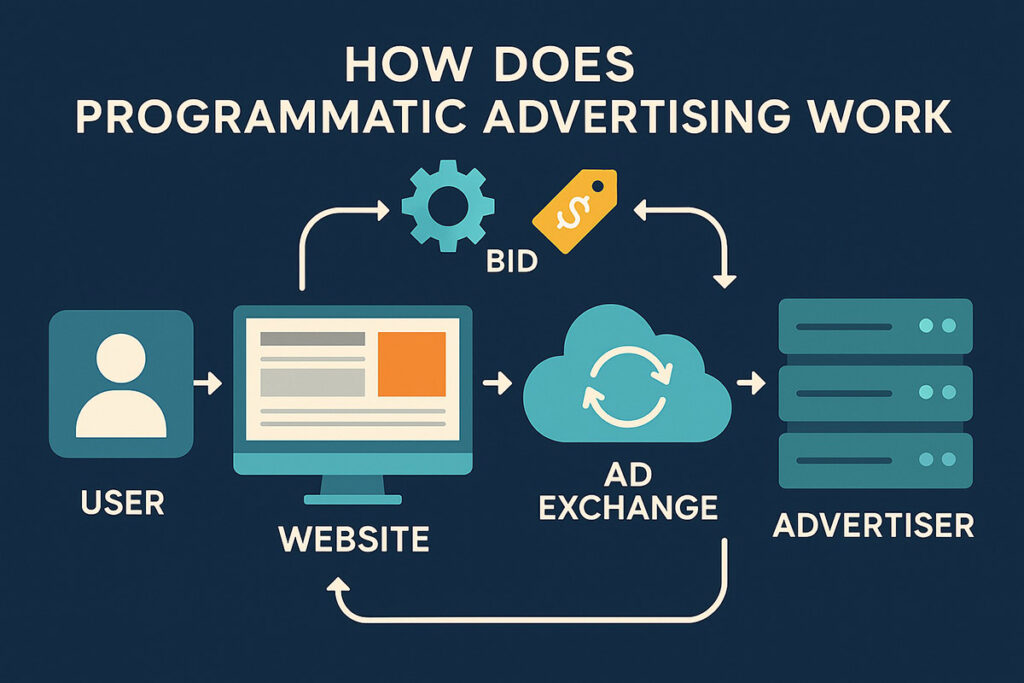
What distinguishes programmatic ads is not the format but the way they are bought: through platforms that analyze audience data, bid for ad space in real time, and serve ads almost instantaneously. This enables advertisers to reach highly targeted audiences based on criteria like location, interests, online behavior, and device type.
By replacing traditional IOs (Insertion Orders) with software and real-time analytics, programmatic ads offer efficiency, scale, and precision that manual buying simply can’t match. From large enterprise campaigns to small-budget initiatives, programmatic methods allow for flexible, performance-driven advertising.
How Does Programmatic Advertising Work?
Programmatic advertising operates through a digital auction system known as Real-Time Bidding (RTB). When a user loads a webpage or app with ad space, the publisher’s platform (via a Supply-Side Platform or SSP) alerts an Ad Exchange that the space is available.
In milliseconds, multiple advertisers, using Demand-Side Platforms (DSPs), bid for that specific impression based on predefined audience criteria and real-time data.
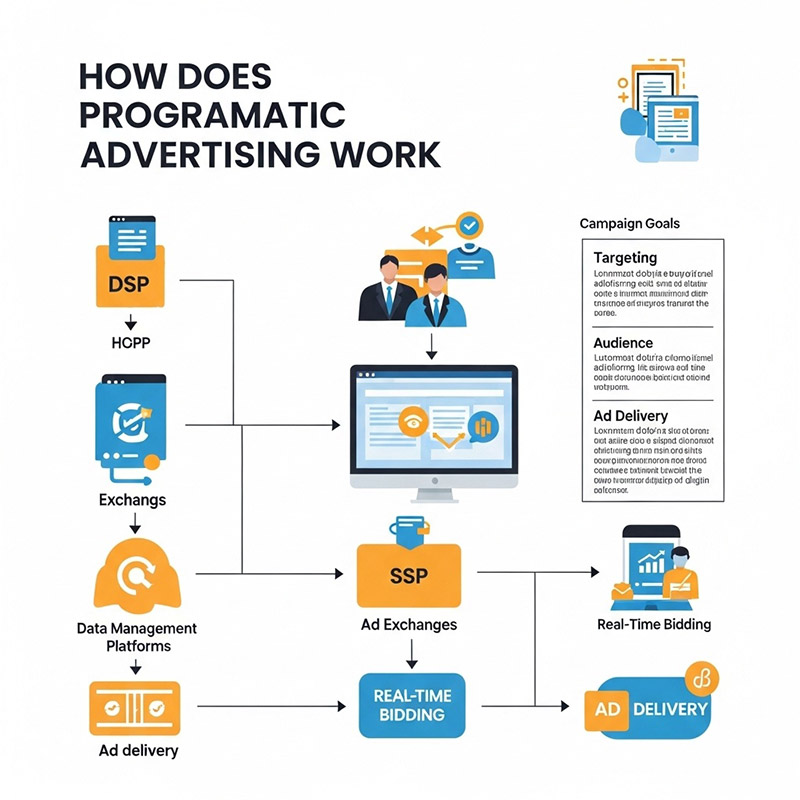
The highest bidder wins the impression, and their ad is instantly served to the user. Behind the scenes, various supporting technologies, such as Data Management Platforms (DMPs) and Customer Data Platforms (CDPs), integrate behavioral and contextual data to optimize the decision-making process.
Because everything happens in real time and at scale, programmatic advertising allows marketers to deliver highly relevant ads to the right people at the most opportune moment, all with unprecedented efficiency.
Types Of Programmatic Buying
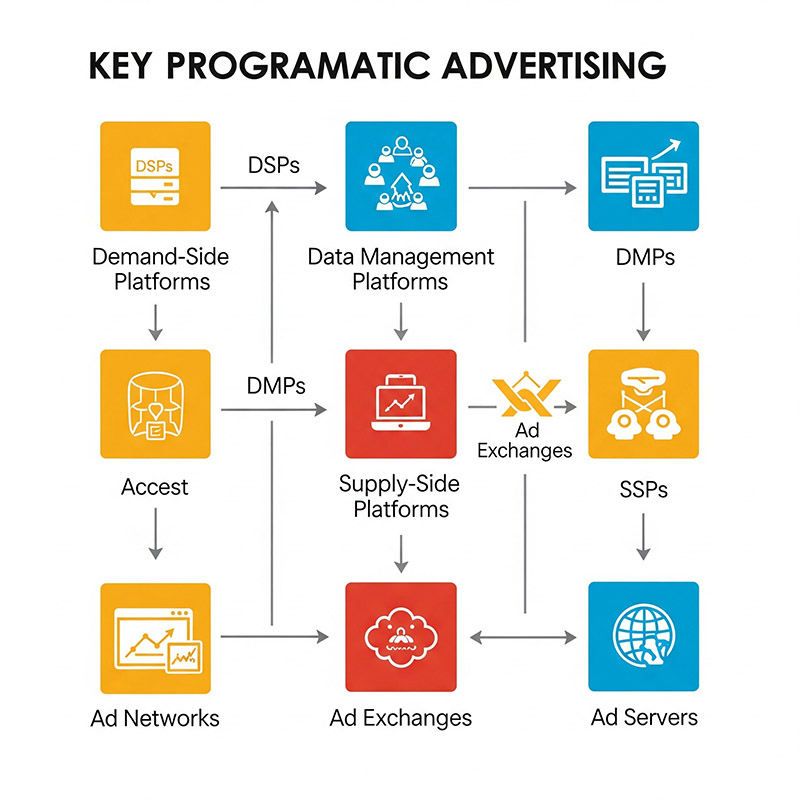
Programmatic advertising relies on a complex but efficient ecosystem of platforms that work together to automate the buying and selling of digital ads. Here are the key components that define how programmatic buying operates:
Demand-Side Platforms (DSPs)
DSPs are platforms used by advertisers to automate the purchase of ad inventory across multiple publishers. They enable targeting, bidding, and campaign management in real time. DSPs evaluate user data and campaign parameters to decide which impressions to bid on and at what price.
Data Management Platforms (DMPs)
DMPs collect, store, and analyze data from various sources (e.g., cookies, CRM systems, third-party vendors) to build detailed audience segments. This data is pushed to DSPs to improve targeting and bidding decisions.
Supply-Side Platforms (SSPs)
SSPs are used by publishers to manage and optimize the sale of their ad space. They feed inventory into ad exchanges and respond to incoming bids from DSPs, often in real time. SSPs help maximize yield for publishers by finding the best-paying advertisers.
Ad Networks
Ad networks aggregate inventory from multiple publishers and sell it in bulk to advertisers. While not as automated or real-time as DSPs and SSPs, they still play a role in programmatic media buying, especially when packaged deals or niche audience targeting is required.
Ad Exchanges
Ad exchanges are digital marketplaces where advertisers (via DSPs) and publishers (via SSPs) conduct real-time auctions. These platforms serve as the transaction layer of the programmatic stack, matching supply and demand for each impression.
Ad Servers
Ad servers are the infrastructure that actually delivers the ads to users. They store the creative assets, track impressions, and ensure the correct ad is displayed based on targeting rules and bid outcomes. Both advertisers and publishers use ad servers to monitor campaign performance.
Benefits And Challenges Of Programmatic Digital Advertising
Benefits
Programmatic advertising introduces several significant advantages:
- Efficiency and speed: The automated system eliminates manual negotiations, speeding up the ad buying process and reducing labor costs.
- Precision targeting: Leveraging vast datasets and algorithms, ads can be tailored by demographics, location, browsing behavior, and device type.
- Real-time optimization: Campaigns can be adjusted dynamically based on performance data, enabling better outcomes at a lower cost.
- Scalability: Access to global ad exchanges allows advertisers to scale campaigns quickly across thousands of sites and formats.
Challenges
Despite its strengths, programmatic advertising is not without drawbacks:
- Data privacy concerns: Reliance on third-party cookies and personal data raises compliance issues under laws like GDPR and CCPA.
- Transparency and brand safety: Advertisers often lack full visibility into where their ads are shown, which may result in misplacement or exposure to ad fraud.
- Technical complexity: Understanding and managing DSPs, SSPs, and DMPs requires expertise and continuous learning.
- Ad fraud risk: Automated systems can be exploited, leading to impressions on non-human traffic or fake websites.
6 Tips To Get Started With Programmatic Advertising
Set Clear Objectives
Before launching any campaign, define what success looks like. Are you trying to build brand awareness, increase website visits, or drive conversions? For example, a fitness brand might aim to grow newsletter sign-ups by 30% in three months.
Clear goals help shape everything, from which audiences to target to what kind of creative you’ll use. Setting Key Performance Indicators (KPIs) like click-through rate (CTR), cost-per-acquisition (CPA), or conversion rate is crucial for campaign optimization. Without defined goals, you risk wasting your budget on unfocused advertising that doesn’t move the needle.
Choose the Right Technology Partners
The tools you use will significantly impact your campaign’s effectiveness. Choose a Demand-Side Platform (DSP) that fits your budget and business size. For instance, a small eCommerce store might start with a self-serve platform, while larger brands could use enterprise-grade tools like The Trade Desk or Amazon DSP.
Look for partners that offer robust targeting options, data transparency, and good customer support. Make sure they are compliant with data privacy laws like GDPR. The tech should match your strategy, not the other way around.
Use First-Party Data for Targeting
First-party data (collected from your own customers or website) is gold. It’s more reliable and privacy-friendly than third-party cookies, which are being phased out. For instance, if you run an online bookstore, you can target users who’ve browsed fiction titles but haven’t yet made a purchase.
Platforms like DMPs and CDPs can help you organize this data to create detailed customer segments. Using this kind of data improves personalization and engagement while ensuring compliance with modern data regulations.
Start Small and Test Often
Don’t go all-in with your budget on Day 1. Start with a small spend and test different creatives, formats (like display vs. video), and targeting settings.
For example, run an A/B test comparing two ad headlines: “Save 20% Today” vs. “Get Fit with Our Gear.” Track which one earns more clicks or conversions. Many DSPs offer built-in analytics to make this easy. Campaigns that actively test and iterate can improve CTR and viewability. For instance, the CheBanca! bank successfully boosted its viewability by 17% and CTR by 40% in just one month.
Monitor Performance and Optimize in Real Time
One of the biggest advantages of programmatic advertising is real-time feedback. Use your DSP’s dashboard to watch metrics like impressions, CTR, CPA, and viewability. If an ad isn’t performing, pause it and test a new version.
For example, if your video ad has a low completion rate, shorten it from 30 seconds to 15 and see if it improves. Adjusting your campaign mid-flight based on real-time data helps control costs and boosts return on investment.
Keep Up with Trends and Regulations
Programmatic advertising is evolving fast, especially with new data privacy rules and AI tools. Follow industry news, take free courses, or attend webinars to stay current. For instance, AI is increasingly used to predict user behavior and automate bid adjustments.
However, with regulations like GDPR and CCPA tightening, you also need to ensure your campaigns are legally compliant. We emphasize making transparency and ethical data use a core part of your ad strategy, not just a box to check.
Case Studies
Magners Cider
Magners launched an innovative mobile-based retargeting campaign using programmatic DOOH (Digital Out-of-Home) advertising combined with AI and geo-fencing. The campaign targeted users in four major UK cities—specifically those most likely to purchase event tickets on impulse. Through machine learning, the campaign delivered dynamic, interactive mobile ads based on real-time location data.
By accurately reaching people at the right place and moment—such as when they were near event venues or on high-traffic streets—Magners saw overwhelming success. All four sponsored events sold out, with demand exceeding capacity and waitlists forming in each city. This campaign exemplifies how precision geo-targeting and automation can create real-world momentum and sell-out engagement.
IHG
IHG, owner of Holiday Inn and Intercontinental, used programmatic ads to encourage travelers to book directly through their platform rather than through third-party booking sites like Expedia or Booking.com, which charge commissions of up to 24%.
The campaign used advanced audience targeting to reach users already considering accommodations. The ads prominently featured a “book direct price,” reinforcing the value proposition. As Matt Luscombe, former COO, explained, this approach helped IHG broaden its reach and reduce reliance on inefficient banner ads. The campaign’s success prompted competitors like Hilton and Marriott to explore similar strategies, making IHG a pioneer in direct-response hospitality marketing.
Audi
In launching its customizable vehicle line, Audi partnered with Google to run a programmatic campaign using Display & Video 360. The strategy combined customer data from multiple sources to create unified profiles and deliver dynamic, personalized ads.
Users could design their ideal car from over 6,000 combinations, and the campaign then served custom ads reflecting each user’s configuration. These highly personalized creatives drove engagement and conversions: the programmatic ads achieved double the efficiency of standard digital ads and yielded a conversion rate four times higher than those bought through traditional media buying.