

For small businesses and large brands alike, marketing ROI is a vital metric. It tells you whether a campaign worked and reveals which marketing strategies deserve more investment and which may need rethinking.
If you’re looking for an ROI calculator for marketing, you’re in the right place! This tool simplifies the process by doing the math for you with just a few inputs. Scroll down for more!
What Is ROI In Marketing?
Return on Investment (ROI or ROMI) in marketing is a way to measure how much profit your business makes compared to what you spend on marketing. In simple terms, it shows whether your campaigns are actually making money or just costing money.
The main benefit of calculating ROI is that it helps you see performance insights – which marketing activities bring the best results. For example, you can compare channels like email, SEO, or paid ads and decide where to invest more. ROI also builds trust with clients, managers, or investors because you can prove that your efforts directly impact business growth.
By tracking ROI, you avoid wasting budget, make smarter decisions, and set realistic goals. In short, ROI tells you if your digital marketing is truly worth the effort.
How To Calculate Marketing ROI?
The ROI Formula
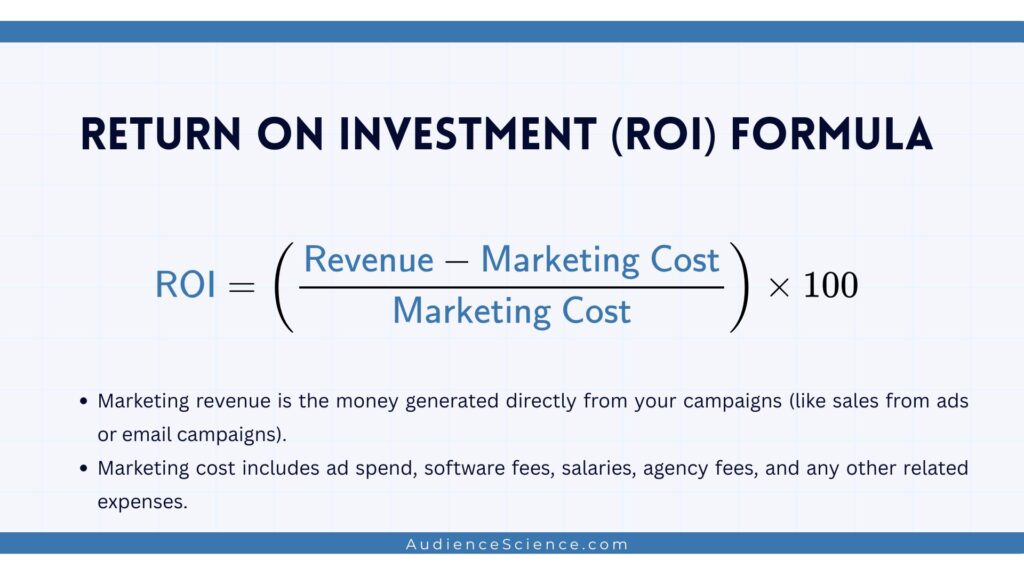
The most common way to calculate marketing ROI is:
ROI = (Revenue – Marketing Cost) / Marketing Cost x 100
Here:
- Marketing revenue is the money generated directly from your campaigns (like sales from ads or email campaigns).
- Marketing cost includes ad spend, software fees, salaries, agency fees, and any other related expenses.
There are also alternative Return on Investment equations depending on your goals:
Marketing ROI Calculator
1. Profit-Based ROI
ROI = Net profit / Marketing Cost x 100
If you want to calculate the money you actually receive, you must subtract the production cost and other additional expenses from the total revenue generated to get the net profit before dividing it by the marketing cost.
2. Organic Sales-Adjusted ROI
ROAS = Revenue from Ads / Cost of Ads
ROI = (Sales Growth – Organic Sales Growth – Marketing Cost) ÷ Marketing Cost x 100
This formula subtracts the sales increase that would have happened naturally (seasonality, holidays, brand growth) to show the true impact of marketing.
3. Return on Marketing Objective (ROMO)
ROMO is not always tied to money. Instead, measures progress toward goals like brand awareness, customer loyalty, or engagement. For example, you measure the increase in newsletter sign-ups or social media reach.
Example
1. General ROI Formula
You run a paid ads campaign costing $10,000. It generates $50,000 in direct revenue.
ROI = (50,000 – 10,000) ÷ 10,000 x 100 = 400%
This means for every $1 spent, you earn $4 in profit.
2. Profit-Based ROI
You spend $10,000 on marketing. Your campaign produces $50,000 in sales. Making the products costs $20,000, and other extra expenses are $10,000.
Net Profit = 50,000 – 20,000 – 10,000 = $20,000.
ROI = 20,000 ÷ 10,000 x 100= 200%
Here, the calculation shows the real profit after covering product costs. For every $1 spent, you actually get $2.
3. Organic Sales-Adjusted ROI
Your sales grew by $40,000 after a campaign. But analysis shows that $10,000 of that growth came from a seasonal event (not marketing). Your campaign cost = $8,000.
ROI = (40,000 – 10,000 – 8,000) ÷ 8,000 = 22,000 ÷ 8,000 = 275%
This shows the campaign truly generated $22,000 in extra sales, not the full $40,000.
Each formula tells a slightly different story. Using more than one method gives a fuller picture of how effective your marketing really is.
Why Is It Difficult To Calculate Return On Investment?
While ROI seems simple on paper, in practice, it can be tricky to measure accurately. Here are some common challenges:
- Attribution problems: It’s hard to know exactly which campaign or channel caused a sale. Customers may interact with multiple touchpoints before buying, making attribution complex.
- External factors: Sales can be influenced by things outside of marketing, like holidays, trends, or economic changes. This makes it difficult to separate natural growth from campaign impact.
- Long-term value: Some marketing strategies, like SEO optimization or content marketing, take months or years to show results. Judging ROI too early may give misleading conclusions.
- Unmeasurable value: Not all marketing aims for direct sales—brand awareness or loyalty campaigns build long-term trust. These outcomes are valuable but harder to link to exact revenue.
- Inconsistent benchmarks: What counts as a “good” ROI varies by industry, business model, and campaign goals. Without proper context, ROI comparisons may be misleading.
An online marketing ROI calculator will simplify the ROI calculation and eliminate the math. You can measure the metric with just 1 click.
FAQs
What affects ROI?
ROI is influenced by many factors, including marketing costs, customer acquisition cost (CAC), lifetime value (LTV), conversion rates, and average order value (AOV). External factors like holidays, economic conditions, and competition can also change results. Attribution challenges, deciding which marketing channel or campaign gets credit, make ROI even harder to pin down.
What is a good ROI?
Benchmarks vary by industry, but generally, 100% (2:1) is acceptable, 500% (5:1) is considered strong, and 1000% (10:1) is excellent. Anything below 2:1 is usually unprofitable once costs are factored in.
What does a 24% ROI mean?
A 24% ROI means you earned 24 cents in profit for every $1 spent on marketing. While it shows you made more than you spent, it may not be high enough compared to industry standards, especially if your overhead and product costs are significant.
How to improve ROI?
Follow these tips:
- Refine targeting to reach the right audience.
- Run A/B testing campaigns to see what messaging works best.
- Optimize customer experience to increase conversions.
- Invest in high-performing marketing channels and reduce spend on weak ones.
- Track metrics more accurately with better attribution and analytics tools.
See more marketing calculator tools: