

Whether you’re running ads on YouTube, TikTok, or Facebook, every marketer faces the same question: how much am I really paying for attention? Cost Per View (CPV) answers this by dividing your ad spend by the number of views. Best of all, calculating CPV only takes a quick formula, yet the insights it provides can shape smarter, more effective ad strategies. Learn more below!
What Is CPV In Marketing?
Cost Per View (CPV) is a way of measuring how much you spend every time someone watches your video ad. It’s a common pricing model on platforms like YouTube, Facebook, and TikTok. To calculate CPV, you simply divide the total amount you spent on ads by the number of views they received.
Tracking CPV is important because it helps you understand if your video ads are reaching people efficiently. A low CPV means your budget is bringing in more views, which is great for building brand awareness. By looking at CPV, marketers can see which platforms, audiences, and ad styles work best.
It also helps compare video performance against other models like cost per click (CPC) or cost per thousand impressions (CPM). In short, CPV gives you a clear picture of how effectively your video ad spend turns into real audience attention.
How To Calculate CPV
The Cost Per View Formula
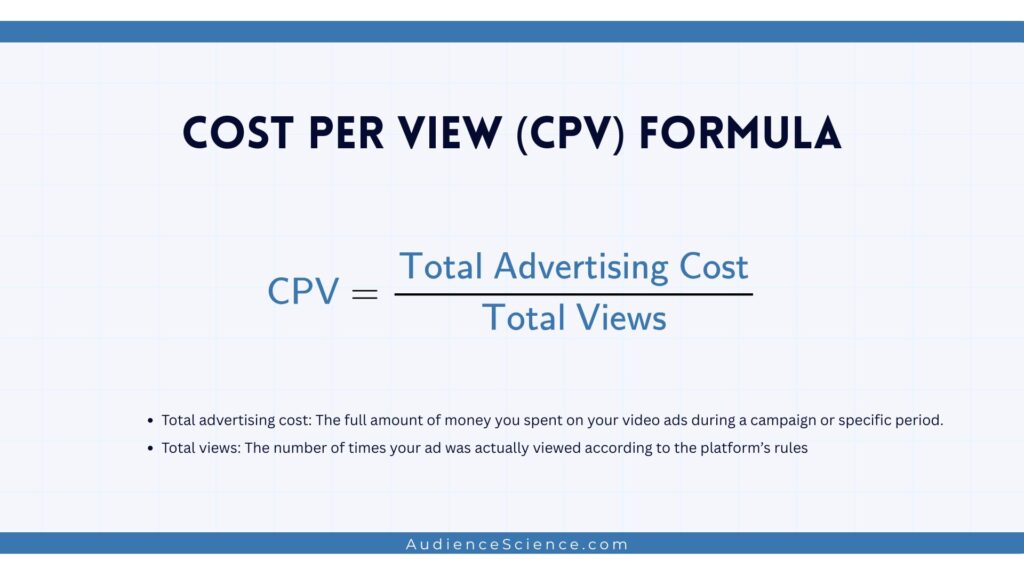
The formula for Cost Per View (CPV) is straightforward:
CPV = Total Advertising Cost / Total Views
Here’s what the terms mean:
- Total advertising cost: The full amount of money you spent on your video ads during a campaign or specific period.
- Total views: The number of times your ad was actually viewed according to the platform’s rules (for example, YouTube usually counts a view after 30 seconds, while Twitter may count it after 15 seconds).
CPV Calculator
This formula tells you exactly how much you paid for each person who watched your video. It’s worth noting that views are not just impressions. Someone has to actively watch your content for it to count. That makes CPV a much better reflection of audience engagement than metrics like cost per impression (CPM).
Example
Imagine you ran a YouTube campaign with a budget of $2,000. Over the course of the ad campaign, your ads received 10,000 valid views (meaning each viewer watched at least 30 seconds or clicked on the ad).
Using the formula:
CPV = $2,000 / 10,000 = $0.20 per view
This means that, on average, you paid 20 cents every time someone watched your video ad. If another video advertising campaign with the same budget had generated 20,000 views instead, the CPV would have dropped to $0.10 per view, showing that it was more cost-efficient in generating attention.
FAQs
What Is A Good CPV?
A “good” CPV usually falls between $0.03 and $0.30 per view, but the right range depends on your industry, target audience, and goals.
For example, brand awareness campaigns may accept a slightly higher CPV if the content builds recognition, while performance-driven ad campaigns aim for the lower end to stretch budgets further. The key is that your CPV should fit within what your business can afford for each person reached.
When To Use The CPV Calculator?
A CPV calculator is helpful whenever you’re planning a new video ad campaign or reviewing past results. It lets you test different budgets and view scenarios to understand potential costs in advance. Marketers also use it to compare campaigns across platforms like YouTube, TikTok, and Facebook to see which one is more cost-effective.
How To Decide On The Maximum CPV Bid?
When setting a maximum CPV bid, consider three things:
- Reach: how many people you want to reach.
- Budget: how much you’re willing to spend in total.
- Spend per view: how much you can afford for each valid view.
A higher bid can increase your ad’s visibility and placement, but it will also eat into your budget more quickly. Balancing cost and reach ensures you get both exposure and efficiency.
How To Optimize CPV?
To lower CPV and get better results, you can:
- Refine targeting so ads reach the most relevant audience.
- Invest in quality, engaging video content to encourage people to keep watching.
- Test different platforms and ad formats to find the best-performing ones.
- Optimize landing pages and calls-to-action so viewers take the next step after watching.
- Measure CPV alongside other metrics like CPM, CPCV, and CPI for a full view of campaign performance.
How Does Cpv Differ From Cpcv?
CPV (Cost Per View) charges advertisers when a video ad is viewed for a set amount of time (for example, 30 seconds on YouTube or 15 seconds on Twitter). CPCV (Cost Per Completed View) only charges when the viewer watches the entire video from start to finish.
Can You Rely On A CPV Calculator?
Yes, CPV calculators are generally accurate as long as the data you enter is correct. What matters most is that your campaign numbers, including spend and view count, come directly from the ad platform’s reporting. The calculator gives a reliable snapshot, but it’s best used alongside other metrics like CPM, CPC, or CPI for a full picture of campaign success.
See more marketing calculator tools: