

Conversion rate is one of the most telling metrics in digital marketing. It reveals how effectively your ad campaigns turn visitors into real customers or engaged users. Knowing the conversion rate of a website, ad, email, or social media post helps you gauge performance, uncover bottlenecks, and refine strategies for better results.
If you’re new to this metric, keep reading as we’ll break down what conversion rate means, how to calculate it with simple formulas (or tools), and the best practices you can apply to steadily improve this key KPI.
What Is Conversion Rate In Marketing?
Conversion Rate in marketing is a metric (in percentage) that measures how much your marketing effort is converted into real actions, such as purchases, clicks, downloads, or registrations. It equals the percentage of visitors or customers who take actions after browsing.
A higher conversion rate implies a more effective marketing campaign, which translates to more leads or sales. This metric assesses marketing performance and helps identify areas for improvement. This insightful data informs future marketing strategies of your business, such as redesigning websites/landing pages, personalizing ads/posts/emails, or using more impactful CTAs.
How To Calculate Conversion Rate
The Conversion Rate Formula
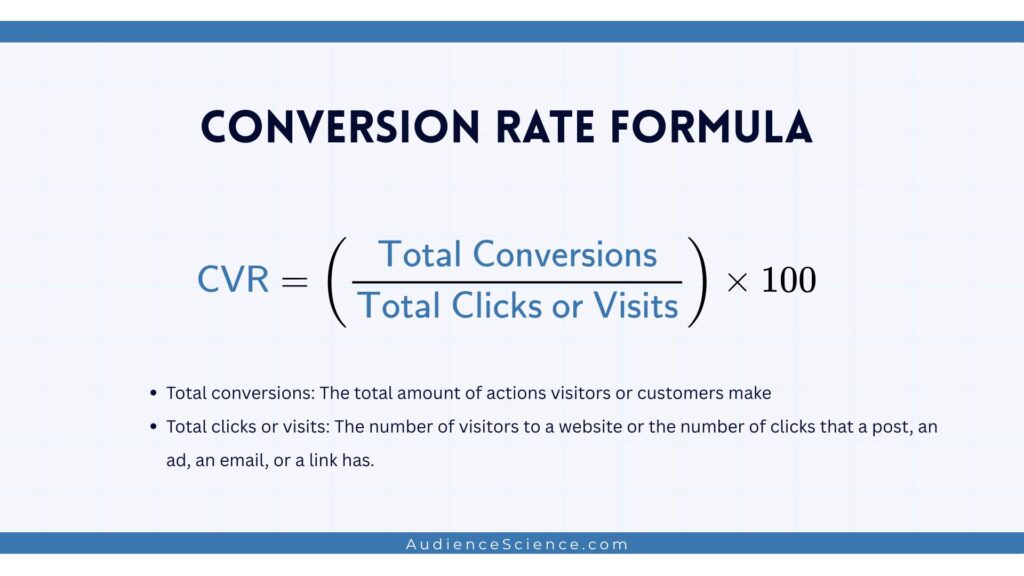
To figure out the conversion rate, follow this formula:
CVR = (Total conversions / Total clicks or visits) x 100
In which:
- Total conversions: The total amount of actions visitors or customers make, such as purchases, registrations, or subscriptions. This can vary across different fields. For example, for an e-commerce site, conversions are the number of purchases. Meanwhile, conversions on an Instagram account refer to the number of shares, comments, and interactions.
- Total clicks or visits: The number of visitors to a website or the number of clicks that a post, an ad, an email, or a link has.
Conversion Rate Calculator
Notes: This conversion rate is measured during a specific period of time.
For websites, a visit is usually counted as a session, since each session can lead to a conversion. In Google Analytics 4 (GA4), you can track either user conversion rate or session conversion rate. The older version of Google Analytics only used session conversion rate (called just conversion rate), so choose that if you’re not sure.
You can use a conversion rate calculator for sales and marketing if you don’t want to do the math.
Examples
For websites
Let’s say your fitness center’s website attracts 2,000 visits this month, and the number of registered members through the form provided on the website during this time is 90.
In this case, the conversion rate in this month is:
(90/2,000) x 100 = 4.5%
Keep measuring the rate in the next month to compare the effectiveness and adjust your marketing strategies properly.
For ads, posts, and marketing campaigns
For example, you run a Facebook ad for 2 months to sell your T-shirt. During this period, the total clicks were 1,230, and 98 T-shirts were sold through the ad.
The conversion rate of this ad is:
(98/1,230) x 100 ≈ 7.97%
Another example is an email marketing campaign to drive more learners for a course. Let’s say there are 950 clicks on the registration link in total, and 51 learners really enroll in the course after clicking.
The conversion rate of this campaign is:
(51/950) x 100 ≈ 5.37%
8 Tips To Boost Conversion Rate
Your conversion rate is lower than average? Try these strategies for conversion rate optimization:
- Use text-based CTAs in blog posts: Instead of relying only on banners at the end, insert contextual text-based CTAs within the body of blog posts to capture attention and drive more leads.
- Add high-converting popups (lead flows): Popups like slide-ins or banners offering valuable resources can convert visitors at higher-than-average rates when well-timed and relevant.
- Run A/B testings on landing pages: Testing different headlines, layouts, or form lengths helps identify what resonates best with your audience and can dramatically improve conversions.
- Streamline your forms: Shorter, simpler forms reduce friction and increase completion rates; only ask for essential information, and use progressive profiling for more details later.
- Leverage retargeting campaigns: Re-engage visitors who didn’t convert by showing them targeted ads on platforms like Google or Facebook, increasing chances they return and take action.
- Optimize high-traffic blog posts: Identify blog posts that attract visitors but underperform in conversions, then update CTAs, add relevant offers, or refresh content to capture more leads.
- Enable real-time support with live chat: Adding chatbots or live chat on high-value pages like pricing can answer questions instantly and reduce hesitation to convert.
- Use the PIE framework for prioritization: Evaluate potential projects by their Potential, Importance, and Ease to focus efforts on initiatives with the highest expected impact.
FAQs
What affects conversion rate?
Some factors, such as calls-to-action, user experience, website interface and design, content quality, website credibility, page load speed, and personalization, significantly affect the conversion rate.
What is a good conversion rate?
The average conversion rate across different industries is 2.35%, according to WordStream. So, if your conversion rate is higher than this threshold, it’s considered “good.” However, the median of the top 25% Google Ads accounts hovers around 5.31%, while that of the top 10% soars to 11.45%. So, you might have to shoot for at least 5% to stand out.
Is a 2.7 conversion rate good?
It depends on your industry. For instance, the average conversion rate in the e-commerce field is just 1.84%, so 2.7 is a superior metric. But for finance, where the median conversion rate is 5.01%, this number still falls short.
Is a 3% conversion rate good?
A 3% conversion rate is considered good in most industries, higher than the average 2.35%. That said, the top 25% and top 10% CVR are much higher.
See more marketing calculator tools: