

In digital marketing, every dollar spent needs to drive measurable results. That’s where Cost Per Acquisition (CPA) comes in. This is a powerful metric that tells you exactly how much it costs to gain a new customer or encourage a valuable action, such as a purchase or sign-up.
CPA calculation empowers businesses to evaluate the true efficiency of their campaigns. Keep reading to learn how to calculate CPA
What Is Cost Per Acquisition?
Cost Per Acquisition (CPA) is a digital marketing metric that tells you how much money it costs to gain one new customer or make someone take a specific action, like signing up for a newsletter. In simple terms, it shows the average price you pay for each sale or conversion that comes from your ads.
By looking at CPA, businesses can see if their marketing is cost-effective and which channels are working best. For example, if one campaign has a lower CPA than another, it means you are getting customers more cheaply through that channel.
This metric is important because it connects directly to profit: if your CPA is higher than what a customer is worth to your business, you may be losing money. Keeping CPA low while maintaining quality leads helps companies grow more efficiently.
How To Calculate Cost Per Acquisition
The CPA Formula
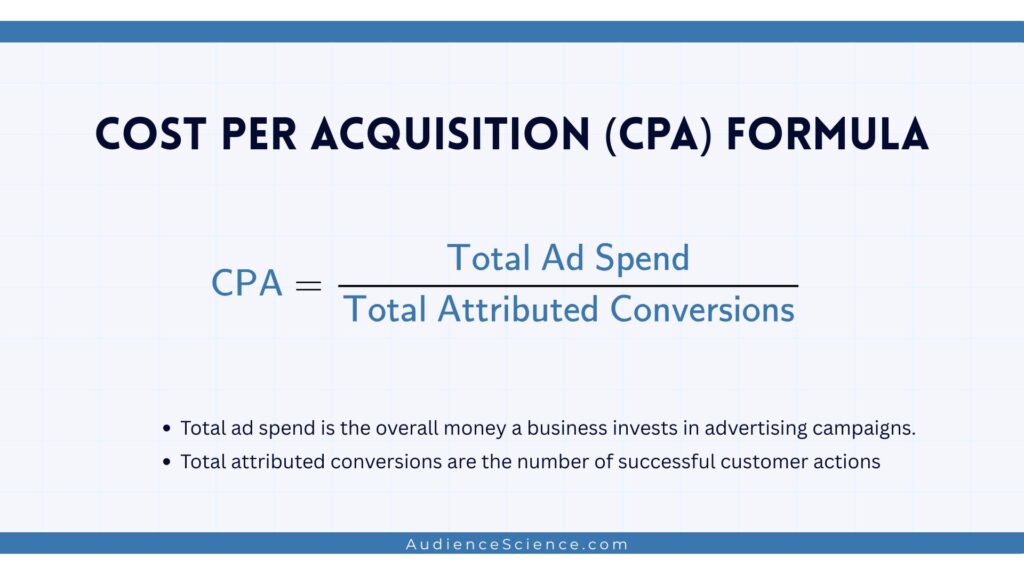
The standard way to calculate Cost Per Acquisition (CPA) is:
CPA = Total Ad Spend ÷ Total Attributed Conversions
In which:
- Total ad spend is the overall money a business invests in advertising campaigns. This includes everything paid for displaying ads, such as search ads, social ads, or banner placements.
- Total attributed conversions are the number of successful customer actions (purchases, sign-ups, downloads, etc.) that resulted directly from those ads.
CPA Calculator
There’s also an alternative formula:
CPA = CPC ÷ Conversion Rate
Here, CPC (Cost Per Click) represents the average amount you pay each time someone clicks on your ad. The conversion rate is the percentage of those clicks that turn into paying customers or other valuable actions.
This version of the formula is useful when you don’t have campaign-wide totals but know your CPC and conversion rate.
Step-by-step Guide
Calculating cost per conversion is simple if you follow these three steps!
Step 1. Calculate total ad spend
The first step is to figure out how much money was spent on advertising. Instead of only looking at a lump sum, you can calculate it from the ground up:
Total Ad Spend = Number of Clicks x Average CPC
For example, if an ad campaign received 1,000 clicks, and each click cost $2, multiplying these two numbers gives you the full ad spend—$2,000.
Step 2. Determine total attributed conversions
Once you know the spend, identify how many customers or actions can be linked back to this campaign. This could be purchases, new sign-ups, or form submissions.
Many businesses track this through analytics tools or by calculating conversion rate x total clicks. This step ensures you are measuring the actual impact of your ads.
Step 3. Calculate CPA
Finally, apply the formula:
CPA = Total Ad Spend / Total Attributed Conversions
The result tells you the average cost of gaining one new customer through the campaign. A lower CPA indicates greater efficiency, while a higher CPA may signal that you’re spending too much to acquire each customer.
Example
A company runs an online campaign with 200,000 clicks at an average CPC of $5. This gives a total ad spend of $1,000,000. During the same campaign, the company gained 4,000,000 conversions. Dividing spend by conversions:
CPA = $1,000,000 / 4,000,000 = $0.25
So, each customer acquired through this campaign costs just 25 cents. This shows the campaign was highly efficient in turning ad spend into results.
Tips To Reduce CPA
Here are some tips to help you optimize CPA:
- Optimize landing pages: A clear, fast, and persuasive landing page increases conversions, lowering your average CPA. Small changes like better headlines or A/B testing can make a big difference.
- Streamline the checkout process: Remove hidden costs and simplify steps to reduce cart abandonment. A smoother checkout flow means more completed purchases.
- Target the right audience: Use precise targeting to reach people most likely to convert. This reduces wasted clicks and improves efficiency.
- Leverage retargeting campaigns: Remind interested users who didn’t convert the first time. Retargeting often delivers cheaper conversions than acquiring cold leads.
- Focus on high-value customers: Following the Pareto principle, prioritize attracting repeat buyers. Long-term customers drive more revenue, making CPA costs more worthwhile.
FAQs
What is a good CPA?
A good CPA depends on the business model and customer lifetime value (CLV). In general, marketers aim for a CPA that is significantly lower than the revenue a customer brings in over time. A common benchmark is a 3:1 CLV-to-CPA ratio. For example, if a customer is worth $300, spending around $100 to acquire them is considered healthy.
What factors affect CPA?
Several factors influence CPA, including ad quality, targeting, and channel type. Campaign budget and bidding strategy also matter. Higher bids can raise CPC, which increases CPA.
Conversion rate is another key driver: the more people who complete an action after clicking, the lower the CPA. Even the landing page design and checkout experience can significantly affect overall acquisition costs.
Is CPA only used for digital marketing?
No, CPA is not limited to digital marketing. While it is most common in online advertising channels like PPC, social media, and affiliate marketing, the concept applies to any customer acquisition activity. Offline campaigns, such as direct mail or event marketing, can also be measured using CPA by comparing campaign costs against the number of new customers gained.
When should I use CPA?
You should use CPA when your campaign’s goal is to drive concrete results like purchases, sign-ups, or subscriptions. It’s widely applied in PPC advertising, affiliate marketing, display ads, social media marketing, content marketing, eCommerce, and EDMs (email direct marketing).
See more marketing calculator tools: