

Email open rate is one of the most widely used metrics in email marketing, but it’s often misunderstood. At its core, it measures how many recipients open your emails after they’re delivered. This figure helps you gauge the strength of your subject lines, the quality of your email list, and your timing strategy.
Open rate calculation helps you gain insights into how engaging your emails are and where you can improve. The calculator below will help!
What Is Email Open Rate?
Email open rate is a simple but powerful metric in email marketing. It shows the percentage of people who opened your email out of the total number of delivered emails.
This number is important because it tells you how well your subject lines, preview text, and sending time are working. A high open rate means your audience is curious and finds your message worth opening. A low open rate may suggest your emails are not reaching the right people, ending up in spam, or failing to grab attention.
Calculating open rate helps you compare email campaigns of different sizes and track engagement over time. It also guides improvements, like writing better subject lines, personalizing content, improving the email design, or sending emails at the right time. While open rate isn’t the only measure of success, it’s a key first step in understanding if your email strategy is working.
How To Calculate Open Rate
The Open Rate Formula
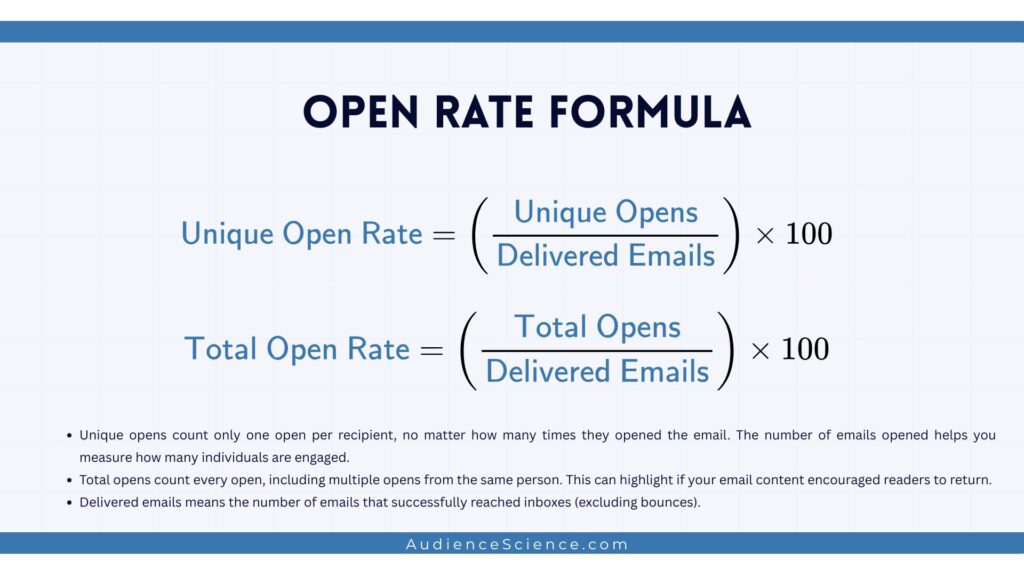
The open rate shows how many people opened your email compared to how many actually received it. There are two ways to calculate it:
Unique Open Rate = (Unique Opens / Delivered Emails) × 100
Total Open Rate = (Total Opens / Delivered Emails) × 100
In which:
- Unique opens count only one open per recipient, no matter how many times they opened the email. The number of emails opened helps you measure how many individuals are engaged.
- Total opens count every open, including multiple opens from the same person. This can highlight if your email content encouraged readers to return.
- Delivered emails means the number of emails that successfully reached inboxes (excluding bounces).
Open Rate Calculator
Example
Imagine you sent 1,000 emails. Out of these, 200 people opened the email, but some of them opened it more than once, leading to 300 total opens.
Unique Open Rate = (200 ÷ 1,000) × 100 = 20%
Total Open Rate = (300 ÷ 1,000) × 100 = 30%
Here, the unique open rate shows how many people engaged at least once, while the total open rate shows deeper interest through repeat opens.
Average Email Open Rate By Industries
According to GetResponse, the overall average email open rate across all industries in 2024 stands at 42.53%, while the average click-to-open rate (CTOR) is 11.95%. Apple’s Mail Privacy Policy inflates open rates to some degree.
Here’s a breakdown of open rates and CTOR by industry (industries shuffled for originality):
| Industry | Open Rate | Click-to-Open Rate |
| Publishing | 39.89% | 14.43% |
| Travel | 32.83% | 7.69% |
| Legal Services | 47.26% | 25.63% |
| Financial Services | 34.70% | 15.40% |
| Non-profits | 54.54% | 12.29% |
| Agencies | 39.26% | 11.96% |
| Restaurants & Food | 38.52% | 6.33% |
| Technology & High Tech | 44.72% | 16.54% |
| Arts & Entertainment | 51.19% | 8.13% |
| Real Estate | 42.71% | 8.23% |
| Sports & Activities | 37.28% | 18.43% |
| Automotive | 39.69% | 14.51% |
| Health & Beauty | 38.16% | 5.62% |
| Communications | 65.14% | 13.29% |
| Retail | 41.77% | 12.22% |
| Education | 41.33% | 7.68% |
| Internet Marketing | 32.62% | 9.74% |
| Health Care | 43.95% | 7.01% |
| All Industries | 42.53% | 11.95% |
FAQs
What is a good email open rate?
A good email open rate is higher than the average open rate across industries, which is about 42.53%. However, what counts as “good” also depends on several factors, including your industry, audience type (B2B vs. B2C), and the purpose of the email campaign.
In addition, your own historical performance matters. Improving your past averages is just as important as beating industry benchmarks.
What affects open rate?
Several factors can influence open rates in email marketing campaigns:
- Subject lines: Engaging, personalized email subject lines encourage more opens.
- Send timing: Emails sent when your audience is active perform better.
- Personalization & segmentation: Targeted content resonates more than generic emails.
- Email list quality and email validation: Inactive or invalid addresses lower email engagement.
- Email deliverability: If emails land in promotions or spam folders, open rates drop.
How do email open rate and click-to-open rate differ?
Open rate measures how many recipients opened the email compared to how many were delivered. Meanwhile, click-to-open ratio measures how many people clicked a link inside the email out of those who opened it. So, open rate shows initial engagement, while CTOR shows post-open user engagement.
How to calculate click-to-open rate?
The formula is:
CTOR (%) = (Unique Clicks / Unique Opens) × 100
For example, if 200 people opened your email and 50 clicked a link, then:
CTOR = (50 ÷ 200) × 100 = 25%.
See more marketing calculator tools: