

If you want to know whether your content is really working, engagement rate is the metric to watch. It goes beyond vanity numbers like reach or impressions and focuses on actions, such as likes, comments, shares, and clicks, that show real interest. This makes it an honest reflection of how much your audience values what you post.
Let’s learn how to calculate this metric and track how well your content performs!
What is Engagement Rate?
Engagement rate is a way to measure how much people interact with your content, whether it’s a social media post, an ad, or a campaign. Instead of just looking at how many people see your content, engagement rate tells you how many actually react to it through likes, comments, shares, clicks, or other actions.
This matters because it shows how well your content connects with your audience and whether it sparks real interest. Tracking engagement rates helps you understand what type of content resonates most, how loyal or active your audience is, and where improvements are needed.
It also gives you a quick sense of whether your strategy is on track and lets you compare your performance over time and even see how you stack up against competitors. In short, engagement rate turns raw numbers into insights about audience connection and content quality.
How to Calculate Engagement Rate?
The Formula for Engagement Rate
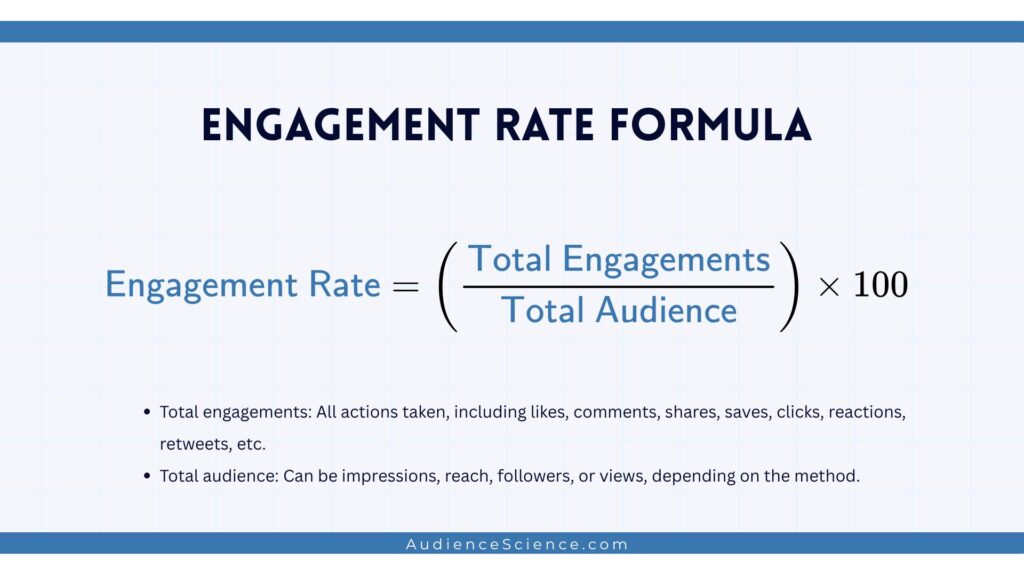
At its core, engagement rate measures how much interaction your content receives compared to the number of people who see it. The general formula is:
Engagement Rate = (Total Engagements / Total Audience) × 100
- Total engagements: All actions taken, including likes, comments, shares, saves, clicks, reactions, retweets, etc.
- Total audience: Can be impressions, reach, followers, or views, depending on the method.
- Multiplying by 100 to get the percentage.
Engagement Rate Calculator
Here are the common variations:
- By Post: (Post engagements / Followers) × 100
- By Reach: (Engagements / Reach) × 100
- By Impressions: (Engagements / Impressions) × 100
- By Views: (Engagements / Video Views) × 100
- Daily Engagement Rate: (Daily Engagements / Total Followers) × 100
Each version highlights a slightly different angle. Calculating the engagement rate by post focuses on your community, by reach on exposure, and by impressions or views on visibility.
Example
Facebook Post Example
A brand’s post gets 500 likes, 100 comments, and 50 shares = 650 total engagements. The post was seen by 12,000 people (content reach).
ER by Reach = (650 / 12,000) × 100 = 5.4%
Instagram Post Example
An influencer has 20,000 followers. A post receives 800 likes, 120 comments, and 80 saves, so the total engagements are 1,000.
ER by Post (Followers) = (1,000 ÷ 20,000) × 100 = 5%
These examples show how engagement rate adapts to the platform: Facebook often emphasizes reach, while Instagram commonly uses followers to measure post performance.
FAQs
What are the types of engagement rate?
Engagement rate can be calculated in different ways depending on the platform and the type of content:
- By post: Compares total post engagements (likes, comments, shares, saves) with your total follower count.
- By reach: Looks at engagements divided by the number of people who actually saw the content.
- By impressions: Measures engagement against the total number of times content was displayed, even if the same person saw it multiple times.
- By views: Designed for video content, it measures engagements relative to total video views.
- Daily engagement rate: Averages the daily interactions compared to the total followers or audience size.
What is a good engagement rate?
A good engagement rate is usually between 1% and 5%, but this varies across platforms:
- Instagram: 3.5% – 6% = very high; 1% – 3.5% = average/good.
- Twitter (X): 0.33% – 1% = very high; 0.02% – 0.33% = good.
- YouTube: 7.72% – 9.44% = very high; ~4.5% = average.
In general, smaller accounts tend to have higher engagement rates, while larger accounts find it harder to maintain the same level.
How to calculate the engagement rate of a video?
For videos, the most common approach is:
Engagement Rate (Video) = (Total Engagements ÷ Total Views) × 100
Total engagements are likes, comments, shares, saves, and clicks, while the total views are the number of times the video was played, not just impressions. This method shows how actively viewers interact with the video content itself.
How to boost engagement rates?
Improving engagement takes both strategy and consistency. Some proven ways include:
- Create relevant, high-quality content that speaks to your audience’s interests.
- Be consistent in posting so followers know when to expect new content.
- Use interactive formats like polls, questions, carousels, or short videos.
- Leverage top-performing content by analyzing what works and double down on it.
- Engage back by replying to comments and messages to build stronger relationships.
- Optimize timing by posting when your audience is most active.
- Adapt by platform. Short reels or stories may work on Instagram, while detailed videos perform better on YouTube.
See more marketing calculator tools: