

Imagine running a campaign this week and wanting to know if it actually worked. Should you keep it, adjust it, or drop it? Week-over-Week (WoW) growth rate gives you the answer. By comparing this week’s results with last week’s, you can see trends forming in real time. It’s fast, simple, and works across many industries.
This week-to-week calculator will help you measure this metric in no time!
What Is The Meaning Of Week-Over-Week?
Week-over-Week (WoW) growth shows how a number changes from one week to the next. It is a simple way for short-term comparison, allowing you to see if things like sales, website visits, or customer sign-ups are going up or down compared to the previous week. Businesses use WoW growth rate because it helps them spot short-term trends and quickly understand the effect of a new campaign, promotion, or event.
The main benefit of WoW analysis is speed. Instead of waiting for monthly or yearly reports, you can react right away if performance improves or drops. It also gives a fair comparison, since weeks usually follow a similar pattern of weekdays and weekends. This makes WoW useful for checking marketing results, product launches, or audience engagement.
However, the WoW growth rate has limits. Weekly updates can be noisy, especially for small businesses or seasonal industries, and results may not reflect long-term progress. For bigger business decisions, it is also better to check month-over-month or year-over-year growth.
How To Calculate Week-Over-Week Change
The Week-Over-Week Formula
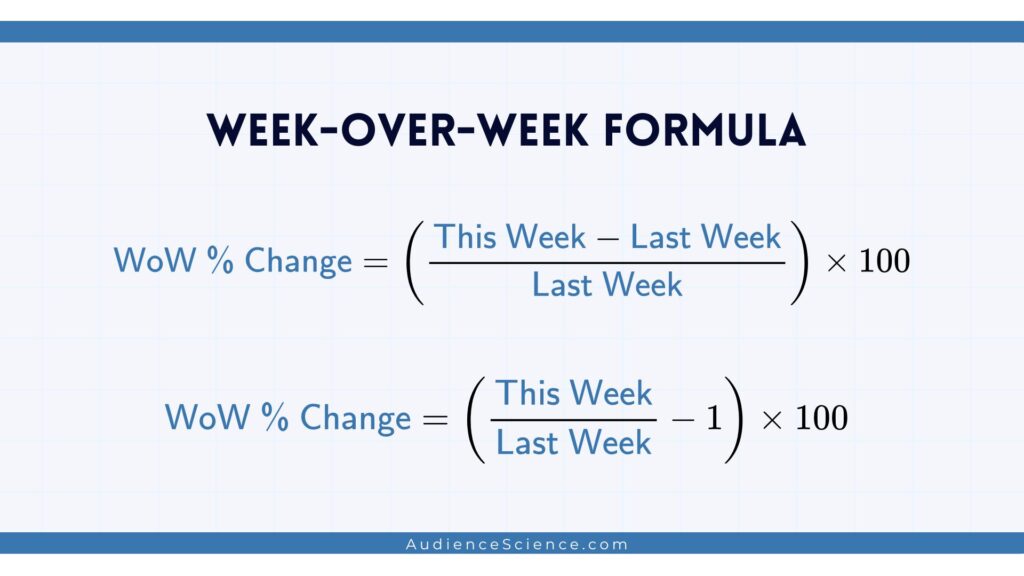
The most common formula for calculating Week-over-Week (WoW) change is:
WoW % Change = (This Week−Last Week) / Last Week × 100
This formula tells you the percentage increase or decrease compared to the previous week. It is straightforward and works with any metric, such as sales, website traffic, or subscribers.
Week over Week % Change
An alternative version is:
WoW % Change = (This Week ÷ Last Week − 1) × 100
Both formulas give the same result, but the second one emphasizes the growth ratio before converting to a percentage.
Alongside percentage change, businesses sometimes track absolute change (this week – last week) and growth factor (this week ÷ last week). These extra views help understand both the scale and the pace of growth.
Example
Example 1:
Imagine an online clothing store that sold $10,000 worth of products the previous week. After running a flash sale and promoting it through social media, sales increased to $12,000 this week. Using the first formula:
WoW % Change = (12,000−10,000) / 10,000 × 100=20%
This means the store achieved a 20% week-over-week increase in sales, showing the campaign was effective.
Example 2:
Now consider a software company that gained 200 new subscribers last week. However, after a price change, only 150 people signed up this week. Using the second formula:
WoW % Change = (150 ÷ 200 − 1) × 100=−25%
Here, subscriptions fell by 25% WoW, highlighting that the pricing change may have discouraged potential customers.
FAQs
When to use WoW?
Week-over-week is best used when you want to measure short-term performance and see the immediate effect of changes. For example, it is helpful after launching a marketing campaign, testing a new feature, or running a promotion. It’s also useful for tracking fast-moving metrics like website traffic, online sales, social media engagement, or app downloads, where weekly snapshots can guide quick decisions.
When not to use the Week-over-Week calculation?
WoW is not reliable in industries with strong seasonal patterns (like tourism or holiday retail), where weekly fluctuations are expected. It is also less useful when dealing with small data sets, because random changes may look like big swings. Finally, it shouldn’t be used for long-term planning. For strategic decisions, monthly, quarterly, or yearly growth rates are more stable and reflect long-term trends better.
Who should use WoW?
WoW is especially valuable for startups, e-commerce stores, digital marketers, and SaaS companies that need to act quickly. It also benefits consultants and small businesses monitoring marketing or sales performance. Any organization in a competitive or fast-changing environment can use WoW to detect early trends and react faster.
How do week-over-week and month-over-month differ?
WoW focuses on short-term changes between one week and the previous week. It highlights immediate shifts, making it good for testing and optimization. Meanwhile, MoM looks at performance changes between months. It smooths out weekly noise, making it better for medium-term analysis and evaluating strategies over a longer horizon.
See more marketing calculator tools: