

Click-through rate (CTR) is one of the simplest yet most powerful marketing metrics. It tells you how well your ads, emails, or search results convert impressions into engagement. High CTR means you’re speaking your audience’s language; low CTR means it’s time to refine.
A CTR calculator makes this process faster and more accurate, giving you actionable insights to boost engagement and ROI. Keep reading to learn how to calculate CTR!
What Is CTR?
Click-through rate is the percentage of people who click on a link, ad, or search result after seeing it. Marketers use CTR to understand how well their ads, emails, or web content capture attention. A high CTR means the message is relevant and engaging, while a low CTR suggests the content or targeting may need work.
CTR calculation is important because it shows if campaigns are effective at driving traffic, not just being seen. It also impacts costs in platforms like Google Ads, where higher CTRs can improve ad ranking and reduce cost per click.
For marketers, CTR is a quick way to compare campaigns, spot what resonates with audiences, and make better decisions to boost engagement and return on investment.
How To Calculate Click-Through Rate?
The Formula For Click-Through Rate
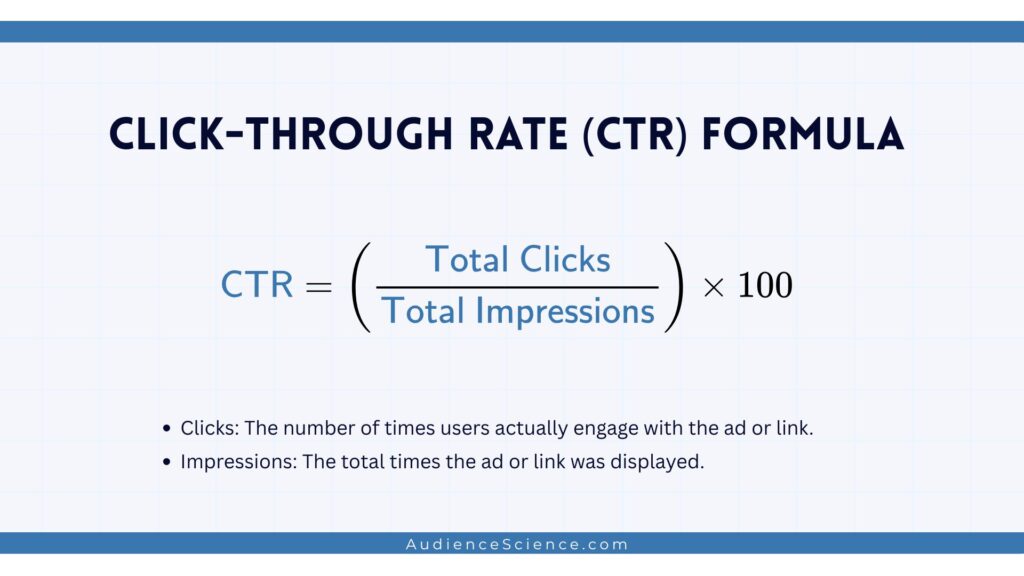
CTR is measured by dividing the total number of clicks that an ad, link, or search result receives by the total number of impressions (the number of times it was shown), and multiplying by 100 to express it as a percentage.
The CTR formula:
CTR = (Total Clicks / Total Impressions) x 100
In which:
- Clicks: The number of times users actually engage with the ad or link.
- Impressions: The total times the ad or link was displayed.
This formula is universal and applies to all digital marketing channels, including search ads, display ads, emails, and even organic search listings. It’s important to remember that a high CTR suggests your message resonates with your target audience, while a lower-than-average CTR implies that targeting, design, or copy needs improvement.
CTR Calculator
Example
Imagine you’re running a search ad campaign for a new product. Your ad was displayed 20,000 times (impressions) and received 600 clicks.
Now, plug the numbers into the formula:
CTR = (600 / 20,000) × 100 = 3%
This means that among the total viewers of your ad, 3% of them really clicked on it.
Marketers can then compare this 3% CTR against industry benchmarks to decide whether to optimize their ad copy, targeting, or visuals. For example, search ads often average around 3.17%, so this CTR still falls short of the industry standard.
FAQs
What is the standard CTR?
The “standard” CTR isn’t fixed. It depends on the type of ad, the platform you’re running ads on, and the industry you operate in. Here are some benchmarks for context:
By ad type:
- Display ads on websites: ~0.46%
- Search ads: ~3.17%
- Email campaigns: ~2.44%
By platform:
- Google Ads: 4.70%
- Facebook Ads: 1.73%
- LinkedIn Ads: 0.56%
What is a good CTR?
A good CTR is one that’s higher than your industry average. For instance, 5–6% may be strong for legal services, while arts and entertainment campaigns often aim for 12% or more. Essentially, a “good” CTR is one that outperforms peers in the same niche.
Is a higher CTR always better?
Not always. While higher CTR usually means stronger engagement, it can backfire if clicks don’t convert into sales or leads. For example, targeting irrelevant but popular keywords may boost CTR but waste ad spend if those visitors don’t take valuable actions.
What affects CTR?
CTR is influenced by many factors:
- Ad copy and headlines (clarity and appeal)
- Design and visuals
- Call-to-action (CTA) strength
- Targeting and audience relevance
- Placement, timing, and device type
- SEO elements like meta titles and descriptions in search results
Why use an online CTR calculator?
Online CTR calculators save time and reduce errors compared to manual math. They let marketers instantly measure CTR, compare campaigns across platforms, and uncover optimization opportunities. This is especially useful when managing multiple ads, emails, or SEO campaigns simultaneously, where small miscalculations can distort results.
See more marketing calculator tools: